Checking owners' association documents and the deed of division when selling an apartment
When selling a Dutch apartment, request these eight owners' association (VvE) documents, ideally before the first viewing: the deed of division with its drawing, the regulations, the minutes of the last two meetings, the annual accounts and budget, the long-term maintenance plan (MJOP), the reserve fund balance, the association's statement and the building insurance policy. Below, what to check in each.
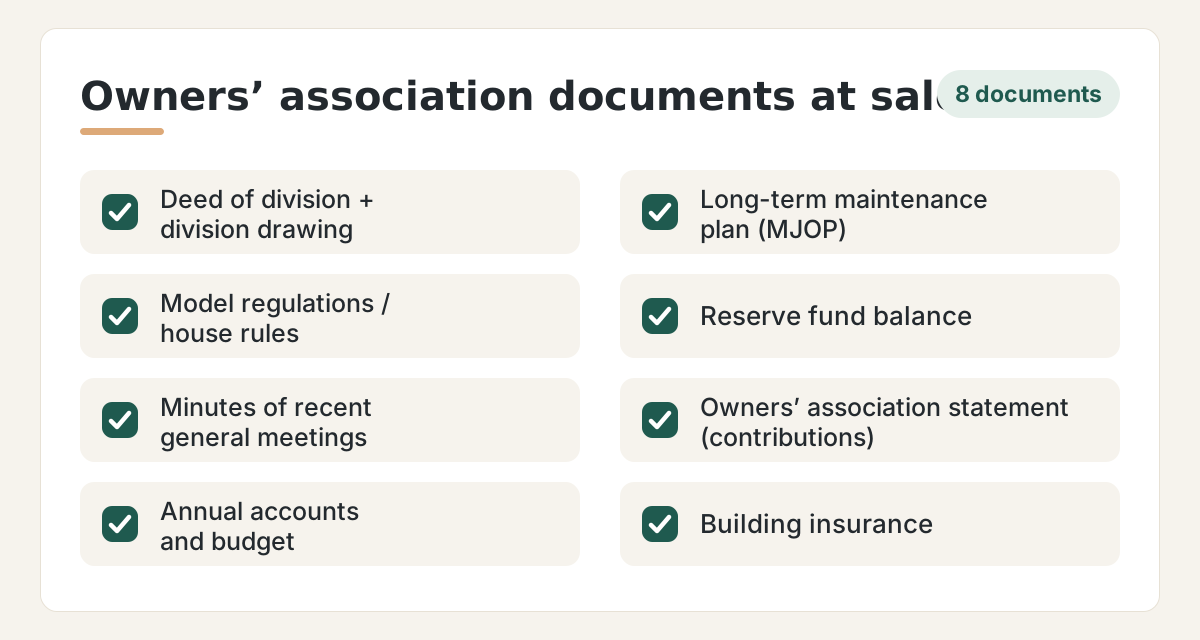
The deed of division and the drawing
The deed of division (splitsingsakte) sets out exactly what belongs to the apartment. Check four things:
- Use. Is the unit described as a home, or as business space or storage?
- Share. The deed states the share of each apartment right. It usually determines how much an owner contributes, and often how many votes they have; that depends on the regulations. If the deed says nothing, the shares are equal.
- Regulations. The deed usually refers to a model regulation of the Royal Dutch Association of Civil-law Notaries (KNB), for example the 1992, 2006 or 2017 version. Check whether the deed deviates from it.
- Drawing. The division drawing shows which spaces are private: storage room, balcony, garden or parking space.
You request the deed and the drawing together from the Kadaster. What else belongs in the dossier is in what goes into a property dossier.
Minutes of the meetings
Read at least the minutes of the last two meetings. That is where the decisions that cost money are recorded: major maintenance, an extra contribution, a loan, a dispute with an owner or a change to the house rules. A buyer wants to know this before making an offer, not at the notary.
Reserve fund and maintenance plan
Since 2018, an owners' association must set money aside every year for major maintenance: at least the amount from a long-term maintenance plan (MJOP), or at least 0.5% of the building's rebuild value (Article 5:126 of the Dutch Civil Code). An MJOP only counts if the meeting has adopted it, it is no older than five years and it covers at least ten years. So an MJOP is not mandatory, but without one it is harder to tell whether the fund is large enough.
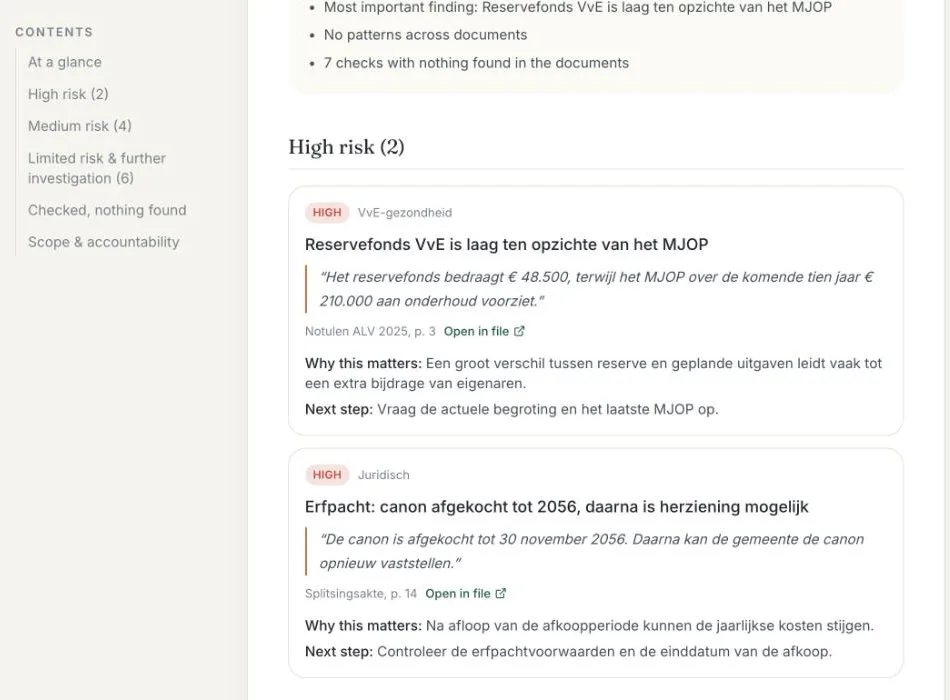
Compare the reserve fund balance with the costs the MJOP expects over the coming years. If the fund is too small, an extra contribution may be needed later.
The association's statement at transfer
The buyer is liable, together with the seller, for contributions that became or will become due in the current or the previous financial year (Article 5:122 of the Dutch Civil Code). That is why the notary attaches a statement from the association's board to the deed of transfer. It shows what the seller still owes and how large the reserve fund is. Request it in good time: a dormant association often has no board that answers quickly.
Is the association registered?
Since 2008, an owners' association must be registered in the Business Register kept by the Netherlands Chamber of Commerce (KVK), even when it is dormant. Check the registration with the KVK. The buyer's bank may ask about it.
All documents in one dossier
Eight documents, often hundreds of pages together. In Huisdoc you add them to the dossier for the address and see straight away what is there and what is missing.
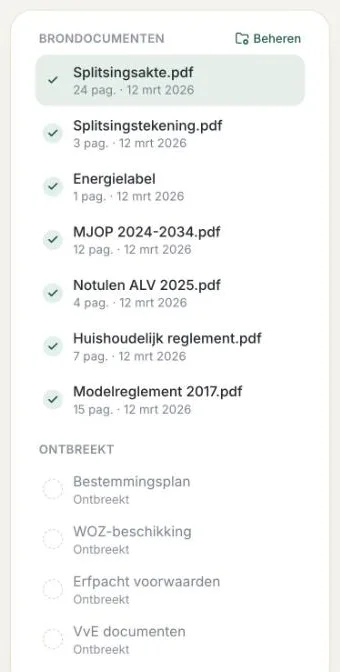
Then ask your question, for example: “Is the reserve fund large enough for the MJOP?” The answer names the document and page, so you can read it yourself.
Smart costs €69 and Wise €99 per user per month, excluding VAT. The first week is free. A team of five or more? You get a custom office price. Ask for an office price.
Frequently asked questions
- Is a maintenance plan (MJOP) mandatory?
- No. The association must still reserve every year: the amount from an adopted MJOP or at least 0.5% of the rebuild value.
- Where do I request the deed of division?
- From the Kadaster, together with the division drawing.
- Who pays outstanding contributions after the sale?
- The buyer is liable, together with the seller, for contributions that became due in the current or the previous financial year. The association's statement attached to the deed shows what is outstanding.
- Which minutes should I read?
- At least those of the last two meetings. The usual sale questionnaire for an apartment asks for them too.
Sources
- Dutch Civil Code Book 5, Articles 5:109, 5:111, 5:113, 5:122 and 5:126
- Government of the Netherlands: reserving for major maintenance (Dutch)
- Kadaster: requesting a deed of division (Dutch)
- KVK: registering an owners' association
This article is not legal advice. If in doubt, ask the notary.