Property dossier: what goes in? A checklist for selling a Dutch home
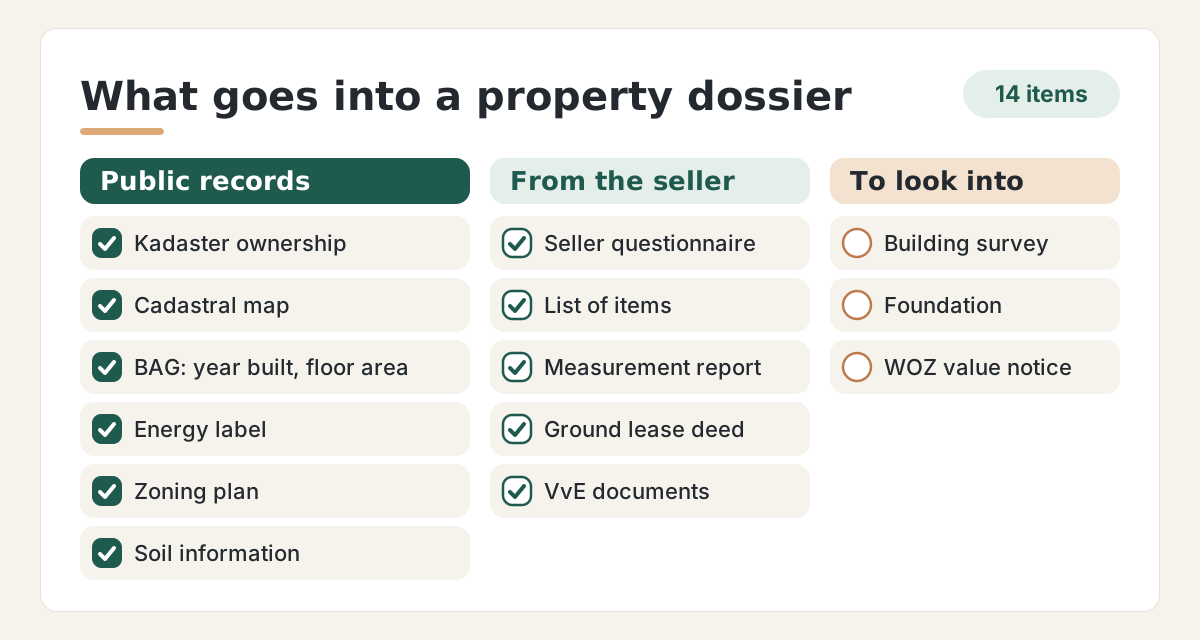
A practical property dossier can be divided into three parts: public records (Kadaster, BAG, energy label, environmental plan and soil information), documents from the seller (questionnaire, list of items, measurement report and, for an apartment, the owners’ association documents) and additional matters to investigate (building condition, foundations and WOZ value). Here is what to check in each part.
Public records
- Kadaster. Ownership information and the cadastral map: who owns the property, the plot and limited rights such as a ground lease or an easement.
- BAG. Year built, floor area and intended use. Does it match what the seller says?
- Energy label. Check EP-Online to see which valid energy label is registered. More on this below.
- Environmental plan. Since 1 January 2024, the former zoning plans (bestemmingsplannen) have formed part of the municipality's environmental plan (omgevingsplan). You can view the rules through Regels op de kaart in the Omgevingsloket.
- Soil. Soil information about the plot and its surroundings, for example through the Bodemloket.
The energy label
When selling a home that is subject to the energy label requirement, the seller must make a valid energy label available to the buyer (Besluit bouwwerken leefomgeving, Bbl, Article 6.27). An energy label is valid for ten years; check its registration in EP-Online. A sales advertisement must state the energy label: the letter and the energy performance indicator (Article 6.30). The Human Environment and Transport Inspectorate can impose a fine for a breach; for a private seller, the fine is €550 in 2026. An agreement with the buyer to sell without a label does not change this.
Documents from the seller
- Questionnaire and list of items. What the seller knows about defects, and what stays or goes.
- Measurement report. Since 2010, NVM-affiliated agents have been required by the industry rules to use the Meetinstructie for usable floor area. It is not a statutory measurement requirement.
- Ground lease deed. With a ground lease: which type, the ground rent and until when it has been paid off. See checking a ground lease when selling.
- Owners' association documents. For an apartment: deed of division, minutes, maintenance plan and reserve fund. See checking VvE documents.
What you look into
- Building condition. A building survey is not mandatory, but buyers often ask for one.
- Foundation. There is no general legal obligation to investigate the foundation when selling. Revised valuation guidance on foundation risks has applied since 1 April 2026. If the risk is elevated, further investigation may be needed before the valuer completes the valuation.
- WOZ value. The WOZ notice states the value assessed by the municipality for the relevant valuation date; it is not necessarily the current market value.
Everything in one dossier
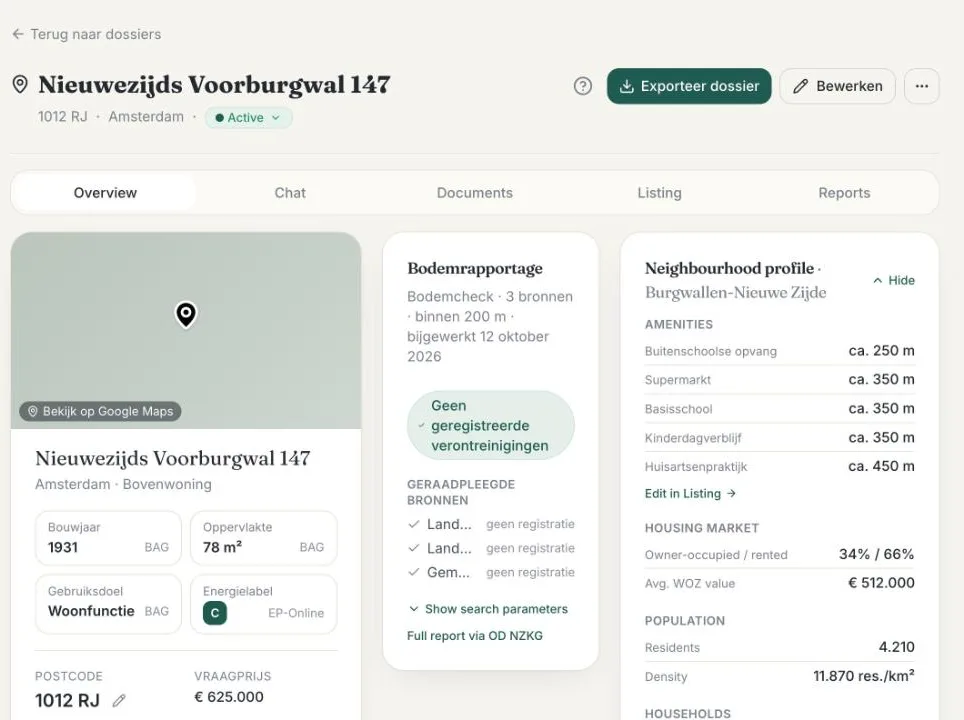
In Huisdoc you type the address and the Kadaster, BAG and energy label data are in the dossier. You add your own documents. Then you ask your question and get an answer with the document and page (see AI assistant with sources).
Smart costs €69 and Wise €99 per user per month, excluding VAT. The first week is free. A team of five or more? You get a custom office price. Ask for an office price.
Frequently asked questions
- How long is an energy label valid?
- Ten years. The label registered in EP-Online is the one that counts.
- What is the fine if there is no energy label?
- The Human Environment and Transport Inspectorate can fine the seller. For a private individual that is €550 in 2026.
- Is the Meetinstructie mandatory?
- Not by law. Within the industry, NVM agents are required to measure according to it.
- Where do I find the zoning plan now?
- In the municipality's environmental plan (omgevingsplan). You can view it through Regels op de kaart in the Omgevingsloket.
Sources (Dutch)
- IPLO: energy label for buildings
- RVO: energy label for homes
- ILT: enforcement of the energy label at sale or rental
- Staatsblad 2025, 401 (fine amounts 2026)
- NVM: Meetinstructie
- IPLO: Regels op de kaart
- KCAF: foundation risk in 2026
This article is not legal advice. If in doubt, ask the notary or a lawyer.